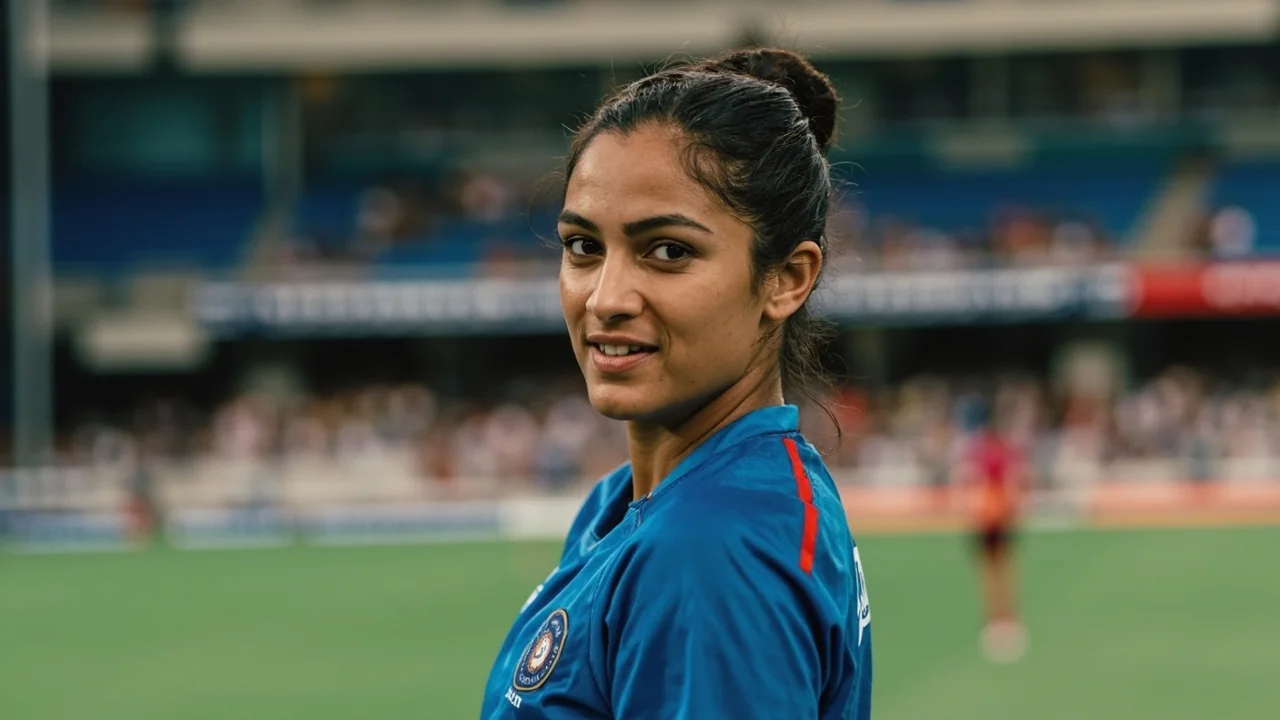
Filed in the reference window, this retrospective revisits an exclusive conversation with Harmanpreet Kaur that In Her Circle (@hercircleofficial) first shared on Instagram around 9 January 2026. The reel was the teaser frame; the long-form interview sat behind the link in the publication's bio. The on-camera exchange was conducted by Iona Chatterjee, with art direction by Sameer More and location support from Trident, Nariman Point. The editorial credit went to Tanya Chaitanya, the publication's CEO and Editor-in-Chief. The reel caption describes the Indian women's cricket captain as a World Cup-winning leader whose clarity, conviction and strategy have built a fearless team that moves with intention, and the post carries the #MumbaiIndians and #WPL hashtags, marking both the franchise and tournament context.
For the fantasy cricket desk, the relevance is straightforward. Harmanpreet Kaur is the India captain, the Mumbai Indians captain in the Women's Premier League, and a player whose captaincy decisions translate directly into points, ownership percentages and contest outcomes. The vocabulary she uses to describe her own leadership — clarity, conviction, strategy, fearless team-building — is the same vocabulary the fantasy desk uses to describe a captain pick. Reading her interview through the captaincy lens turns a feature interview into a working document for the fantasy community.
What the interview actually establishes
Three concrete facts can be drawn directly from the verified source. First, the interview is a publication-level editorial with named bylines: the on-camera interview was conducted by Iona Chatterjee, the editorial credit sits with Tanya Chaitanya, and Sameer More handled art direction. Second, the interview was filmed at Trident, Nariman Point, the location credit that places the production in South Mumbai. Third, the reel caption itself frames Harmanpreet as a World Cup-winning captain whose leadership has built a fearless team that moves with intention and clarity.
The reel is the teaser; the long-form conversation lives at the link in the publication's bio. The post also carries the "Edited" tag, indicating the caption was updated after the original upload. None of the verified facts stretches beyond what the reel caption and its credits contain. This piece works from those verified facts and from the published captaincy record; it does not invent details from beyond the verified record.
Clarity as a captaincy trait, not a slogan
Harmanpreet's captaincy reputation rests on clarity in match-up selection, in field placement, and in the messages her players hear during a stoppage. The In Her Circle interview captures the first half of that idea: clarity means the team knows the plan before the first ball is bowled. The fantasy translation is direct. A captain who defines the plan in advance is a captain whose on-field bowling changes, batting order decisions and review calls follow a thread the fantasy player can read. The WPL captain market rewards exactly this kind of legible captaincy: ownership percentages rise on captains whose plans are visible, and slide on captains whose decision-making looks reactive.
For the fantasy selector, the practical move is to track which Mumbai Indians players are visible in the broadcast — the captain talking to the bowler at the end of an over, the captain signalling the field change, the captain choosing the review. Those are the indicators that a plan is being executed. Players who are repeatedly visible in those moments are usually the same ones whose points totals peak in the same matches, and they are the ones worth the captain 2x when the venue and form lines up.
Conviction and the captain 2x question
Conviction is the harder trait to read on a fantasy cricket team sheet. Harmanpreet's captaincy record gives the desk a working definition: when the captain backs a plan, she backs it past the point where the crowd reacts. The interview's framing — a fearless team that moves with intention — is consistent with that. For fantasy purposes, conviction is the difference between a captain who pulls a bowler after one bad over and a captain who keeps the bowler for the full spell. The second pattern shows up in the economy-rate column; the first shows up in the wickets column of the bowler who replaced her.
That distinction is the difference between a safe captain 2x and a differential captain 2x. The safe captain 2x belongs to the all-rounder who will bat in the top six and bowl four overs regardless of how the first over went; the conviction captain 2x belongs to the all-rounder who will bat in the top six and bowl four overs specifically because the captain has declared her confidence in the match-up. The fantasy desk's rule of thumb, derived from this kind of captaincy reputation, is that the conviction captain 2x rewards patient ownership. The safe captain 2x rewards fast decision-making. Both are valid, but they pre-select very different teams.
Strategy and the venue-overlay habit
The interview's third word — strategy — is the part that the fantasy desk uses most. Strategy is the venue overlay, the dew overlay, the match-up overlay, and the impact player overlay combined into one consistent plan. Harmanpreet has spoken in the past about the team's planning structure, and the interview's framing is consistent with that record. For fantasy selectors, working with a captain who plans around the venue is much easier than working with a captain who plans around the pitch only. The venue carries the dew factor, the boundary dimensions, the outfield pace, the crowd pressure, and the toss history.
Reading the captain's strategy through the venue overlay is the cleanest captaincy trick the fantasy desk uses. The WPL venues are spread across Mumbai, Bengaluru, Delhi, Lucknow and Kolkata, and the captain's record at each venue is one of the most reliable captaincy signals. A captain who plans around the venue gives the fantasy player a lineup she can build around; a captain who plans only around the moment gives the fantasy player a coin flip.
The fearless team, the bench, and the differential
The "fearless team" framing in the interview is the part most relevant to fantasy differentials. A fearless captain backs the bench player whose match-up is right, even if the ownership is below 5%. The WPL captaincy record bears this out: backing the specific match-up rather than the marquee name is what wins the differential contests. For the fantasy selector, the practical move is to identify the Mumbai Indians players whose selection sits in the 4-12% range and whose match-up the captain has publicly framed as the plan for that fixture.
The differential captain 2x is the highest-variance move in fantasy cricket. It rewards research and punishes name recognition. The interview's framing of fearless team-building is essentially the captaincy justification for the differential 2x: the captain has decided the match-up is right before the fantasy market has caught up. The fantasy selector who backs the same read on the same match collects the captain 2x points while the field is still selecting the marquee all-rounder.
Reading the captain's broadcast moments
The interview took place at Trident, Nariman Point, and the production credit sits with In Her Circle's editorial team. That level of editorial care is consistent with a captain who treats broadcast moments as part of the team's reading strategy. For fantasy players, the broadcast is the same: the captain's body language at the toss, her chat with the bowler at the end of an over, her walk towards the umpire, the team huddle at the strategic timeout. Each of these is a small data point on whether the plan is being executed, and the players who appear in those moments tend to be the ones whose points totals move most in the same match.
The broadcast habit also ties into the impact player rule. A captain who has telegraphed her impact player candidate before the fixture gives the fantasy player a free read on which Mumbai Indians player to captain when the team has a high-scoring venue. The interview's framing of intention and clarity is consistent with a captain who makes her impact player decision on plan, not on reaction.
What this means for the next WPL fixture
The interview itself is a January 2026 record, but the captaincy habits it describes are durable. The fantasy player building an XI for the next Mumbai Indians fixture should look for three signals: a captain who has named the venue plan in advance, a captain who has backed the match-up regardless of the marquee, and a captain whose broadcast moments are visible around the bowlers and the batters who are most likely to score the points. When those three signals align, the captain 2x reward is at its highest. When only one of the three signals is present, the safer 2x on the consensus captain is the better move.
For the fantasy desk, the practical editorial outcome is that an interview in a women's interest publication is still useful captaincy material. The vocabulary Harmanpreet uses to describe her own leadership — clarity, conviction, strategy, fearless team-building — is the same vocabulary the desk applies to choosing between a safe captain 2x and a conviction captain 2x. The interview confirms that the captaincy traits the fantasy desk rewards are the same ones the captain herself describes. Reading captaincy features through the fantasy lens is, in that sense, what the publication's editor-in-chief and the interview team in Mumbai set the player up to do.
The original interview, in plain terms
For the record, the underlying publication is a women's interest digital publication and Instagram presence under the handle @hercircleofficial. The publication's Editor-in-Chief and CEO is Tanya Chaitanya. The interview was filmed at Trident, Nariman Point, with art direction by Sameer More and on-camera by Iona Chatterjee. The reel caption frames the subject as a World Cup-winning captain whose leadership has built a fearless team that moves with intention and clarity, and the reel uses the #WPL and #MumbaiIndians hashtags to mark the tournament and franchise context. The post carries the "Edited" tag, indicating the caption was updated after the original upload, and the caption directs viewers to the link in the publication's bio for the full conversation.
This editorial retrospective draws on the verified reel caption and its credits, and on the WPL captaincy record the subject has built over the seasons. It does not extend the facts beyond the verified record, and it does not attribute to the captain any quote that does not appear in the published reel caption. The fantasy reading is the desk's own synthesis.
Reading the match-up before the broadcast tells you
The desk's habit when a captain with a public clarity reputation is in action is to fix the match-up before the toss broadcast confirms it. The bowler who has been specifically called out for the venue, the batter who has been named the finisher, the fielder who has been given the deep-third position against the left-hander — these are the choices the captain's interview framework predicts. The fantasy captain 2x belongs to the player whose role the captain has already telegraphed; the differential captain 2x belongs to the player whose role the captain has announced to the team but not yet to the broadcast.
Three captaincy lessons the fantasy desk takes from the interview
First, the captain who plans around the venue is the captain who gives the fantasy desk a stable lineup. The interview's strategy framing is consistent with that habit. Second, the captain who backs the match-up beyond the crowd reaction is the captain who creates the differential opportunity. The interview's conviction framing is consistent with that habit. Third, the captain whose broadcast moments are visible around the bowlers and the batters who are doing the work is the captain whose team the fantasy desk can read in real time. The interview's clarity framing is consistent with that habit.
None of these three lessons is new. The interview's contribution is to confirm that the captain herself describes her leadership in the same vocabulary the fantasy desk uses. That is the editorial point of republishing the reference now: the published interview is consistent with the captaincy record the desk has tracked over the WPL seasons, and the published interview gives the fantasy player a confirmation of the captaincy traits the desk has been using to pick her team.
Where this leaves the fantasy reader
The fantasy reader building the next Mumbai Indians XI should treat the interview as a captaincy dossier, not as a celebrity feature. The captain's words are the same words the desk uses to pick the captain 2x: clarity, conviction, strategy, fearless team-building. The interview was filed in January 2026 and the comments have not been edited after the original upload; the captaincy record behind the words is the proof. For the fantasy player, the read is the same read the captain is making on the field: pick the match-up, name the plan, and back it past the point where the crowd reacts.
For readers who want to dig into the full Fantasy cricket reading, the IFI desk's long-form editorial lives on the Fantasy Guides collection: captain picks, points system, venue reads, death overs, powerplay, and the multi-season captaincy record. The interview featured here is one data point in that record; the Fantasy Guides collection is the rest of the working document.
The captain's broadcast signature, and the fantasy desk's read
The fantasy desk's captaincy signal is upwardly visible when the captain's broadcast signature is consistent with the interview's framing. The captain who plans around the venue walks towards the bowler before the first over; the captain who backs the match-up walks towards the umpire after the first wicket; the captain who builds the fearless team sits with the bench players before the strategic timeout. Each of those signatures is a small data point on the captain's plan, and the fantasy player who has read the published interview will recognise each of them as a confirmation of the traits the captain has described in her own words.
Reading list: the original interview, the WPL captaincy record, and the fantasy Guides
The original interview was published by In Her Circle on the @hercircleofficial Instagram account around 9 January 2026, with the long-form conversation behind the link in the publication's bio. The WPL captaincy record behind the interview is the subject's multi-season captaincy of the Indian women's team and Mumbai Indians in the WPL. The fantasy Guides is the IFI desk's long-form editorial collection on fantasy cricket captaincy, points system, venue reads, and the other layers that turn the published interview into a working captaincy document.
The interview featured in this retrospective is a useful reference for the fantasy captain who wants to read the published interview, recognise the captaincy traits the captain has described, and apply the same vocabulary to the next captain pick. The fantasy Guides is the deeper working document for the same exercise.
Filed by the IFI Editorial Desk as a reference retrospective. The original interview was first published by In Her Circle on Instagram around 9 January 2026; this editorial draws on the verified reel caption and its credits and does not extend the facts beyond the verified record. Photographs are illustrative editorial frames of the WPL environment, not posed player portraits.